
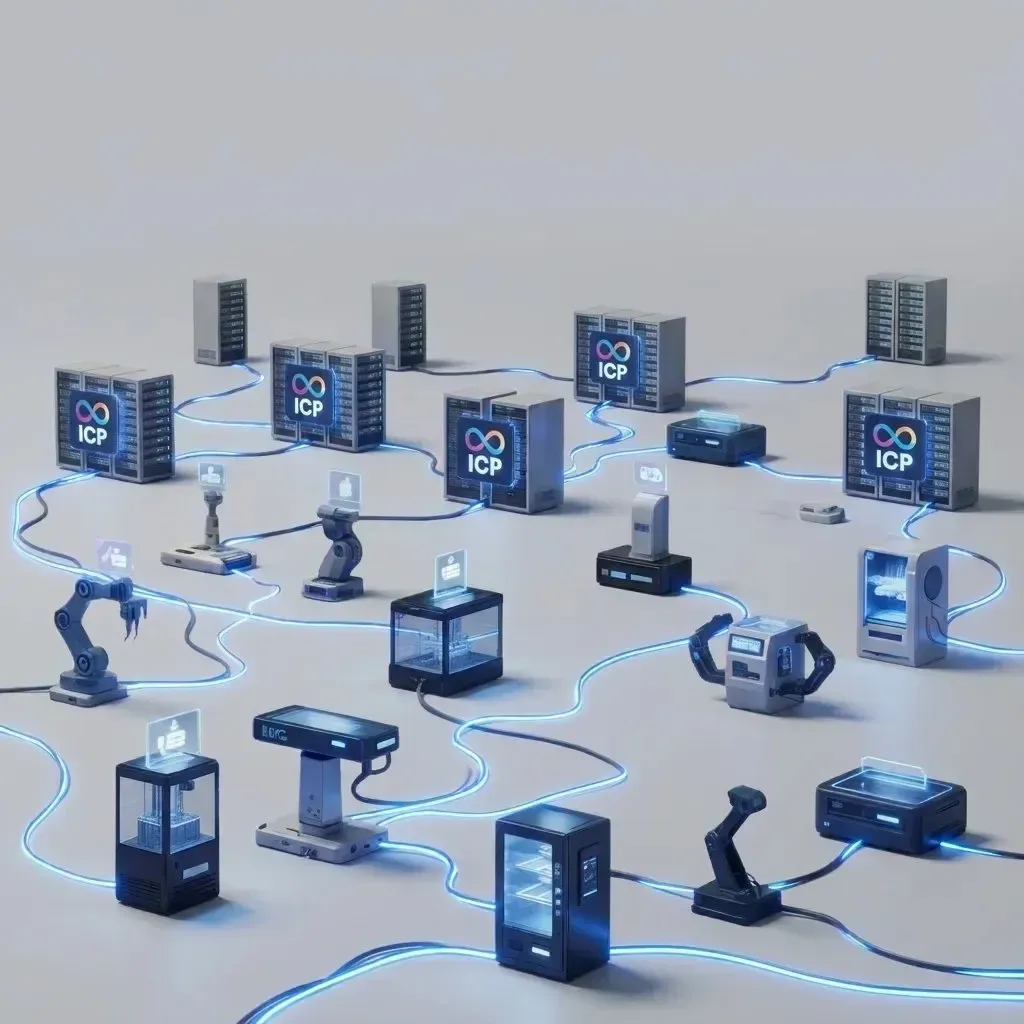
Dfinity will replace the cloud. Redesign it from scratch. Or at least sit on top of it.
The narrative is consistent: ICP as sovereign compute infrastructure. Not just an alternative to AWS, Google Cloud, Azure, but a serious upgrade. On ICP, computation and data live in the same canister. No latency between processing and storage. No fragmented architecture. No third-party database exposed to subpoenas. That’s not feature parity with big cloud, but a fundamentally better design.
But the cloud is not going to be replaced in a hurry.
Everywhere in the world, the story is the same. Governments talk sovereignty. Hyperscalers respond with local data centers, rebranded “sovereign cloud” offerings, deeper lobbying. Policy is slow. Hyperscalers write €10 billion quarterly checks to build infrastructure faster than any government can pass a law, run a tender, or align member states on a standard.
For enterprises, migrating from big cloud means security reviews, compliance certifications, legal opinions, retraining, integration costs. The switching costs are real. The legacy is deep.
THE MACHINE ECONOMY VECTOR
What if there is quicker, simpler, faster traction? A complementary strategy: the Inevitable MACHINE ECONOMY?
Dfinity has every technical primitive required to own this completely different market.
- Persistent on-chain identity.
- Canister wallets — smart contracts with built-in wallets, no bank required.
- Autonomous transactions at sub-cent cost.
- Trustless execution.
- Sovereign compute.
- Reverse gas model — the service pays, not the user.
No other blockchain has this stack. Not Ethereum. Not Solana. Not any L2.
And yet, nobody at Dfinity is talking about THE MACHINE ECONOMY.
Today, ICP burns thousands of dollars in cycles per day. Real computation. Not token swaps, not bot transactions — actual application logic executing on-chain. The network is being used. It’s just being used by humans.
Now add machines.
Every sensor ping. Every autonomous payment. Every maintenance request. Every transaction between an EV and a charging station, an EV and a parking slot, a vending machine and the product supplier. All of it burns cycles. All of it runs on ICP.
The biggest part of the market for cycles isn’t human population. It’s device population. Billions of machines, each transacting continuously, autonomously, without asking permission. Orders of magnitude larger than any human-facing market.
AI agents can’t open bank accounts. No machine has ever signed a contract with Chase. But on ICP, any machine gets a canister wallet in seconds. No paperwork. No approval. No human in the loop. ICP is the only infrastructure in existence where THE MACHINE ECONOMY is actually possible.
Dfinity built it. THE MACHINE ECONOMY is the use case they haven’t yet started to deploy.
WHY THE MACHINE ECONOMY IS THE RIGHT FIRST MOVE
Cloud replacement is a subtraction problem — displacing something entrenched, expensive, and defended. THE MACHINE ECONOMY is an addition problem. Building on empty space. No incumbent. No legacy. No switching costs. No IT department to convince. No procurement committee. No legal review of a 10-year cloud contract.
Machines have no allegiance to AWS. A robot doesn’t have a preferred cloud provider. A CNC machine has no migration plan to protect. Every machine that comes online is a blank slate — and the first protocol to give it an identity, a wallet, and a governance voice owns that machine as a participant forever.
First mover in a greenfield wins by definition. There is no second chance to be the default.
Three barriers kept THE MACHINE ECONOMY from starting. All three are now solved.
Communication. Until recently, communicating with machines meant learning their language — thousands of proprietary protocols, APIs, command lines. Only specialists could do it. AI reversed the burden. Machines now learn human language. You can chat with a machine, send it a video, describe what you want in plain words. The communication barrier is gone.
Transactions. Machines couldn’t hold money. They couldn’t pay or get paid without a human intermediary owning the account, signing the transaction. Canister wallets change this. Any machine gets a wallet in seconds — no bank, no approval, no human in the loop. Sub-cent transactions, autonomous, 24/7.
Identity. A machine with no identity is a tool. A machine with an on-chain identity is a peer — traceable, accountable, governable, capable of entering agreements. ICP Internet Identity extended to devices makes this possible at scale.
Communication. Transaction. Identity. Three barriers, all solved. For the first time in history, a machine can have a full persona — it speaks, it pays, it governs, it exists as an economic peer, a citizen of the network.
This is where bits meet atoms. Not on a screen but in the real world. THE MACHINE ECONOMY is the first market where software and hardware are inseparable by design. You can’t have one without the other. The machine economy didn’t boom before because the infrastructure didn’t exist. Now it does.
WHY IT WINS FASTER
Cloud replacement has a sales cycle measured in years. Government tenders. Enterprise procurement. Compliance reviews. Pilot programs. Budget cycles. Every step requires a human decision-maker to say yes.
THE MACHINE ECONOMY has no sales cycle.
A machine transacts on day one. No migration project. No integration timeline. No 18-month enterprise contract. No committee. The proof of concept is live in weeks. The cycles start burning from the first transaction.
Human markets are capped. Population. Purchasing power. Geography. Working hours. Humans sleep. Machines don’t. Humans retire. Machines depreciate and get replaced by more machines. The addressable market doesn’t shrink — it grows with every device that gains connectivity.
A machine can be an agent, not a passive endpoint: an active participant that senses and acts in the real world, autonomously.
Dom knows this very well. In July 2021, three months after ICP mainnet launched, he spoke about Badlands — a concept for a network of Raspberry Pi nodes run anonymously from homes, costing under $250 each. Intelligence at the edge. Full decentralization. Processing data where it’s generated, not in a central server.
ICP is the only architecture where everything converges: sovereign compute, autonomous wallets, on-chain identity, sub-cent transactions. IoT, DePIN.
SNOWBALL EFFECT
This is not an either/or argument.
Cloud is the infrastructure. THE MACHINE ECONOMY is the killer use case running on top of it. They don’t compete — they build on each other in a positive feedback loop.
And the feedback loop compounds. Every machine that joins the network burns cycles, generates data, creates value for the next machine that joins. The network effect is machine-to-machine — faster, denser, more continuous than any human network has ever been. More nodes make the network more attractive to the next wave of machines.
This is a snowball. Each layer accelerates the next.
WE NEED TO EXTEND ICP TO THE MACHINE ECONOMY
ICP has the protocol. The compute. The architecture. The vision.
What it doesn’t have yet is the physical layer — the bridge between the on-chain world and the machines that will actually run THE MACHINE ECONOMY. Caffeine writes the code. Caffeine doesn’t make a robot transact. It doesn’t give a 3D printer a wallet. It doesn’t put a factory cell on-chain.
That’s not a criticism. It’s a gap. And gaps in greenfields don’t stay open.
The stack is only complete when software meets hardware. When the dapp connects to the machine. When the canister wallet has a physical device behind it. When the agent isn’t just a piece of code running on a server — but a thing in the world, with sensors, actuators, and a persona on ICP. Bits and atoms. Together.
ICP needs an extension to THE MACHINE ECONOMY. A physical layer. An extension from protocol to machine. From canister to actuator. From on-chain identity to a real device operating autonomously in the world.
THAT EXTENSION ALREADY EXISTS.
It’s ALVIN + DAPPSTER. It runs on ICP. It was built for this, precisely.
ALVIN is a software bridge that gives any physical machine a full persona. It speaks. It pays. It governs. A machine with ALVIN becomes an agent. Sensing and acting in the real world, transacting autonomously, participating in its own governance. An economic peer.
ALVIN is built on Dappster. Dappster is a dapp factory — battle-tested, composable building blocks that snap together. Each block works with every other block by design, not by accident. You don’t rewrite primitives from scratch every time you build a new dapp. You assemble, configure, deploy. Onchain.
And here’s where Caffeine connects directly: new building blocks can be generated with Caffeine and plugged straight into Dappster’s fabric. Describe the module you need, Caffeine writes it, Dappster runs it. From idea to deployed machine-ready dapp in days, not months.
Dappster only runs on ICP. ALVIN only runs on Dappster.