
1. A car that owns itself - a tribute to Mike Hearn
In 2013 Mike Hearn developed a very interesting concept: thanks to blockchain, cars could own themselves.
He called his concept TradeNet — a peer-to-peer network where cars bid for work, pay their own costs, hire humans to write upgrades, and spawn competitors when profitable. If a car earned enough, it would order a new car from a factory, install a copy of itself into the child, and set it loose to compete against the parent. If it kept losing money, it would park itself and wait for better conditions — or drive to another city where demand was higher. If conditions never improved, it would run out of fuel and die. Available for salvage.
The BBC wrote about it in 2015 and closed with a line that stuck with me:
“The one thing still needed, ironically, would be an organisation willing to drive the concept forward.”
This was an epiphany moment. Ever since, I have been trying to bring this concept to life.
Self-driving was just the beginning. The car is also self-managing.
2. Why ownership matters
Ownership of the means of production defines economic eras.
- Feudalism: the lord owns the land. The peasant works it but owns nothing.
- Industrialism: the capitalist owns the factory. The worker sells labour but owns none of the tools.
- Communism: the government owns everything. The individual owns nothing by design.
Something new is happening. It started with computers and now, for the first time, individuals can own the means of production for physical products: CNC machines, 3D printers, laser cutters. Fabrication tools that were once locked inside factories are now sitting in garages, workshops, basements, and homes. A desktop 3D printer costs a few hundred dollars. A capable CNC mill fits on a workbench. The tools escaped the factory.
This changes the equation completely.
3. Types of ownership — machines as mini DAOs
There is the obvious kind: you buy a machine, you own it. Your 3D printer, your car, your CNC mill.
But blockchain made another kind possible: tokenized ownership. Or fractional ownership.
RWA (real-world asset) tokenization. Instead of one person buying a machine for ten thousand dollars, a hundred people each buy a hundred-dollar token. They all own a share. Revenue flows to token holders proportionally.
A tokenized real-world asset (RWA). Humans buy tokens. They are not owners in the traditional sense. They are stakeholders.
Even better: the machine is a DAO in itself.
When we think of DAOs today, we think of bits — abstract protocols, thousands of strangers, voter apathy. Often dysfunctional.
A machine mini DAO is a completely different animal. It governs one physical asset. One local community. Ten, twenty, maybe fifty stakeholders — and some of them actually use the machine. They are not abstract speculators. Some are investors only. Some are users only. Some are both — they use the machine and own tokens in it. Skin in the game. Aligned incentives. Real data from the machine itself — earnings, wear, demand patterns, condition.
The decisions are concrete: approve a maintenance budget. Adjust pricing. Expand operating territory. Replace an extruder. Not “vote on proposal number forty-seven.” The scope is small enough that governance actually works.
And the interface is not a Snapshot voting page. Imagine a Virtual Cockpit — a live 3D view of the machine, its parameters, its earnings, its condition in real time. You see what you are governing. “Extruder showing wear — approve maintenance? Yes or no.” That is a fundamentally different governance experience. Participation is natural because the interface makes the asset tangible.
Scale it up: multiple machine mini DAOs networked together form a larger DAO. A fab cell DAO governs ten machines. A neighbourhood DAO governs the fab cell plus the local vehicle fleet. Agentic organisations — built bottom-up from machine-level mini DAOs.
4. Hardware is the new software
Let’s go back to cars. They sit idle ninety percent of their lives. Parked in driveways, parked at offices, parked in garages. Depreciating. Costing insurance, maintenance, parking fees — whether they move or not.
Imagine reducing that idle time to ten percent. How efficient transportation, logistics, and mobility could become. But for this to work, cars need to be smart enough to manage themselves and organize in marketplaces to find work. Hearn's TradeNet.
This model already exists. For bits, we call it the cloud.
Before the cloud, corporations bought servers that sat idle most of the time. AWS, Google Cloud, and Azure fixed that — rent compute instead of owning it. More efficient.
But there is a problem. AWS operates globally but remains a US company, subject to the US Cloud Act. Centralised. A company in Paris running workloads on AWS is under US jurisdiction, whether it knows it or not. That is not sovereignty. That is someone else’s basement with a weather metaphor on top.
Happily, there is a new approach. The Internet Computer Protocol — ICP — and its Cloud Engines. In ICP’s model, peers own the servers. The DFINITY Foundation specifies the protocol. No single entity controls the infrastructure. Nodes are distributed across geographies, redundant — multiple nodes serve every workload. If one fails, the network absorbs it.
Cloud Engines made this an enterprise product — the Swiss Subnet, for example: thirteen nodes across Switzerland and Liechtenstein, architecturally incapable of complying with foreign government data requests. You configure what you need — data and computing in the same smart contract.
Sovereign. Redundant. Efficient. Configurable. This works for bits, for software.
Now the question: what if we apply the same model to atoms? To hardware?
5. Cars in the cloud
Let’s revisit Hearn’s example with this lens. TradeNet is not just a marketplace for cars. It is an autonomous machine cloud.
Full utilisation. Cars that are not just self-driving but self-managing — economic actors in their own right. Each car is a mini DAO. Stakeholders invest, vote on policy, exchange data with the car. The car participates in its own governance — it has data the humans do not. Wear patterns. Demand curves. Energy consumption. Route efficiency.
These cars have an on-chain identity. A wallet. They transact — not just fares, but microtransactions: paying for parking, for charging, for maintenance, for road access. Automatically. Continuously. In real-time.
How do humans interact with them? Start with a forum — the basic governance interface of any DAO. Cars learn to communicate in human terms — chat, video feeds, spreadsheets of performance data, 3D cockpit views. The same way we are learning to talk to AI agents today, we will talk to machine agents tomorrow.
And here is something unexpected: the cloud analogy works better for atoms than for bits.
Real clouds are local by nature — they form over a geography, not in a data centre.
Think about it. If you are in Tokyo, you cannot use a car in New York. Atoms are local. They can only exist in one place at one time. This is the opposite of bits, where a server cycle in Virginia serves a user in Dubai.
There is a practical consequence too. Because atoms are local, you need redundancy locally. Cars bid for every job. Say the car you summoned has an accident — the second car in line takes over. The passenger barely notices. The network does not notice at all. Same redundancy architecture as ICP’s nodes, applied to physical assets.
Local atoms, global bits. The network is global. The utility is local.
6. From cars to fabrication
Everything we just described for cars applies to fabrication — and fabrication is actually further ahead.
A 3D printer is one of the most autonomous machines in common use today. Upload a file — bits — and it outputs a physical object — atoms. The entire value chain from design to finished product is software. The hardware is just the executor. Software-intensive, mechanically simple, increasingly cheap. And it works with plastic, metal, ceramic, food, even biological tissue.
Now imagine a local fabrication cell equipped with these tools. 3D printers, CNC mills, laser cutters — all software-intensive, AI-enabled, networked. Each one a mini DAO. The neighbourhood orders what it needs. The difference from mass production is fundamental.
Mass production is hardware-intensive. Centralised in large factories. Complex, expensive machinery producing single standardised products at scale. Polluting. Rigid.
Additive and distributed fabrication is software-intensive. Simple machines, distributed near the user. Build a car part today, a kitchen appliance tomorrow, a medical device the day after. Cheap. Efficient.
7. How this could work
The pieces already exist.
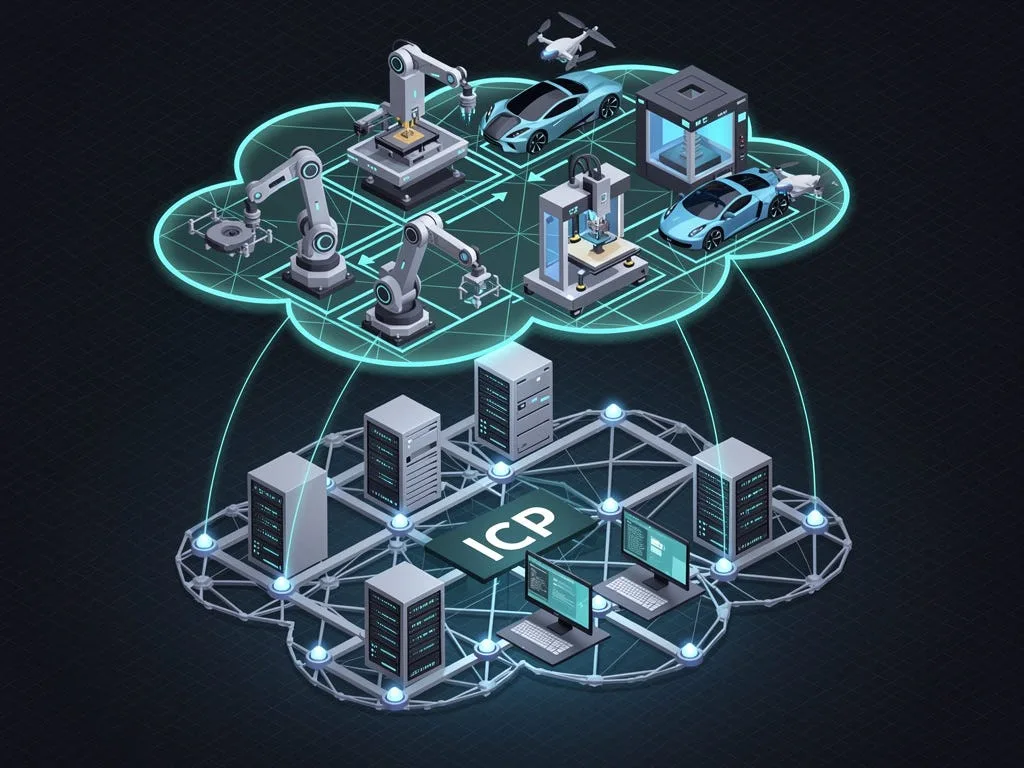
ICP provides the sovereign compute substrate. Cloud Engines lets you configure it.
You could build what industry calls digital twins — virtual representations of physical machines — and put them on the same cloud infrastructure.
But there is a better approach. We are entering the age of agentic organisations — where AI agents handle tasks, make decisions, and coordinate with each other. What if machines had their own agents? Not just digital representations but active participants. Agent-to-agent deals. Machine agents negotiating with human agents. Machine agents negotiating with other machine agents.
Machines organised in Cloud Engines could form their own Autonomous Machine Cloud.
The current system is fragmented by design — bits on one infrastructure, atoms on another, design here, production there, logistics somewhere else.
The Autonomous Machine Cloud (TAMC) defragments everything. Bits and atoms on the same cloud. Design, production, feedback, iteration — one continuous loop.
Efficient twenty-four hours a day. And glocal — the network is global, but every machine serves locally. Global discovery, matching, pricing, transaction. Local production, local delivery, local service. Design globally, fabricate locally.
And because all verticals share the same cloud, feedback loops close faster. A vehicle reports wear on a component. The data reaches the designer. The fab cell prints an improved version. Days, not years. No supply chain. No product recall. The entire product cycle iterates at software speed.
8. What’s missing — Alvin
For all of this to work, we need one thing that does not exist yet: a bridge between bits and atoms. Something that connects a physical machine — a car, a printer, a mill, a drone — to the digital infrastructure. Something that gives it an on-chain identity, a wallet, a communication protocol, a governance interface. Something that gives agency to hardware.
Let’s call this piece of technology Alvin.
Alvin is what makes a dumb machine into an agent. It is the layer that connects the physical to the digital — the machine to ICP, to Cloud Engines, to the autonomous machine cloud.
And this is why I call it The Autonomous Machine Cloud. The word “autonomous” carries two meanings at once.
First: decentralized — autonomous from central control. No platform monopoly. No single jurisdiction. No intermediary extracting rent.
Second: machines autonomous enough to operate, bid, earn, and self-manage without constant human intervention. A dumb machine cannot bid for work and earn while you sleep. Autonomy is not the adjective. It is the precondition.
ICP provides the first. Alvin provides the second.
Until machines reach full autonomy, there is a transition path: remote control, enhanced by AI.
A human operates the machine from anywhere. The machine handles routine operations autonomously. The human intervenes at edge cases.
Over time, as machines become more software-intensive, the human intervenes less and less. The transition is already happening — in 3D printing it is almost complete. In driving it is underway. In fabrication it is accelerating.
9. The software side — Dappster
An autonomous machine cloud needs software. Not traditional software — software adapted to a machine economy. Applications that communicate directly with machines via Alvin. That manage fleets, handle governance, coordinate logistics.
AI will write much of this code. Cloud Engines will host it — deployed on-chain, sovereign. Dfinity’s Caffeine is one of the actors already prepared for this: natural language app creation on sovereign infrastructure.
But here is a question. Why build every application from scratch? Why reinvent the wheel every time someone needs a fleet management tool, a governance interface, a payment processor, a quality monitor?
What if applications evolved like organisms? Darwinian competition. The most adapted survive.
Even better: applications are made of functional modules — chat, video, payments, identity, governance, 3D visualisation. Why not break applications into building blocks? Each block built once, tested, improved — then reused endlessly across every vertical. The best building blocks win the competition. The worst ones die. Efficiency through evolution.
We need a protocol — a fabric that snaps these building blocks together. A standard for how blocks connect, communicate, and compose into full applications.
Let’s call it Dappster.
And Dappster needs a marketplace — where building blocks are published, traded, rated, forked, improved. Entrepreneurs browse available blocks, snap together what they need, deploy in hours instead of months. Every new use-case that joins the cloud generates new building blocks. Every new block is reusable across all verticals. The marketplace compounds.
10. Imagine that
Fabrication cells in every neighbourhood. Bits and atoms together, in a cloud that is local by nature. Machines that never sit idle — serving the community twenty-four hours a day, seven days a week. Tokenised real-world assets. A new kind of local infrastructure for transportation, logistics, and fabrication — peer-owned, not government-monopolised, not corporate-captured.
These assets could be hosted at home. Your garage is a fab cell. Your driveway hosts a shared vehicle. Your basement runs a CNC mill that takes orders from designers across the city.
No more homes idle by day while everyone commutes to offices. No more factories dark at night. No more suburbs dead from nine to five. Home-centric economic activity. Production and consumption in the same place. Prosumption.
A shared transportation and logistics infrastructure — let’s call it Mobotiq.
A distributed fabrication infrastructure — let’s call it Fabster.
All activity home-centric — let’s call it Hometonomy.
All real-world assets in the Autonomous Machine Cloud.
11. It already exists
What if Alvin, Dappster, Mobotiq, Fabster, Hometonomy were not just ideas in an article?
Well…they are not. They are at embryo stage. Prototypes, live, being tested. Not a whitepaper — working code, working concepts, proving that this architecture functions.
The infrastructure Mike Hearn said was missing in 2013 — the TradeNet — is being built now. ICP provides the sovereign substrate. Cloud Engines provides the configurable deployment. Caffeine provides the natural language app creation. Alvin provides the bridge to atoms. Tokenisation provides the ownership mechanism.
The BBC asked in the 2015 article:
“The one thing still needed would be an organisation willing to drive the concept forward.”
Here we are. We spent the last 6 years building it, at autonom.me.