
I write this with Claude. I couldn’t write it without. I’m not a native English speaker, I don’t have time to write. It drafts. It corrects my English. It pushes back when I’m sloppy. I’m not giving that up. AI is useful. I use it daily. This article is not a Luddite take.
The turn:
In the 80s I read Toffler’s The Third Wave (1980). Then Powershift (1990). Then War and Anti-War (1993). Then Revolutionary Wealth (2006). Across four books, one through-line: the structures of the industrial age were artifacts of its limits. Knowledge would become the dominant form of power. War would de-massify. The whole order would loosen.
The corollary I’d add: centralization was never civilization. It was a workaround.
Forty-five years later, the structures are still here — but they’re cracking. Now AI is the test of the rest.
Centralization is a communication artifact
Toffler’s frame, in one paragraph:
For most of human history, we lived in small groups. There were no tools to hold a larger group together — no writing, no roads, no clocks, no way to send a message faster than a horse. Centralization wasn’t possible because the infrastructure for it didn’t exist yet.
Then came the industrial age, the Second Wave. Mass production, mass media, mass schools, mass armies, mass politics. All of it required centralization, because centralization was the only structure that worked when you couldn’t reliably communicate with more than fifty people. The factory, the bureaucracy, the broadcast tower, the chain of command — these were not features of civilization. They were workarounds for the limits of paper, telegraph, and assembly line.
Then came the Third Wave. Computers. Networks. Demassification. Toffler called it in 1980, before the public web. The constraint that produced centralization was about to dissolve. Once communication and information moved freely, the structures we built around their scarcity — the corporations, the hierarchies, the ministries, the broadcasters — would lose their reason to exist. Not overnight. But inevitably.
Forty-five years later, here’s what I’ve actually watched.
Since reading Toffler in the 80s, I’ve watched four technologies promise decentralization and re-centralize within a decade.
- PC, 1980s. Promised personal computing autonomy. Re-centralized into the Microsoft + Intel duopoly within ten years.
- Internet, 1990s. Promised an open commons. Re-centralized into Google, Facebook, Amazon by the late 2000s.
- Mobile, 2000s–2010s. Promised computing in everyone’s pocket. Re-centralized into the Apple + Google app store duopoly within five years of the iPhone.
- Bitcoin and crypto, 2010s. Promised sovereign money. Re-centralized into Coinbase, Binance, Tether, and ETF custodians within a decade.
Each one was a real decentralization at first. Each one re-centralized for the same reason: networks naturally produce monopolies — and once a technology becomes a network, the monopoly is built in.
The PC itself wasn’t a network. But the operating system on top of it was: every developer wrote for the OS with the most users, every user bought the OS with the most software. By 1990, Microsoft had won the network even though IBM had built the box. Same with Intel — the x86 instruction set became a standard, and every program compiled for x86 made x86 more valuable than the alternatives. The hardware was open. The platforms on top were not.
Mobile told the same story, faster. The phone itself was a device. The operating system and the app store were the network. iOS and Android each captured one side of the duopoly within five years, and the lock-in was complete: every app developer ships to both, every user is locked to one. The hardware diversified — Samsung, Xiaomi, dozens of OEMs — but the platforms above the hardware monopolized completely.
Railroads are networks. You don’t need more than one railroad between Manchester and London. Once a network is built, the marginal cost of adding the next user falls toward zero, and the value of the network for everyone grows with each user added. Network effects compound. The first platform to reach critical mass becomes the default. The default becomes the monopoly. This isn’t a failure of regulation — it’s a property of networks themselves.
Toffler’s insight stays true: when communication tools improve, decentralization gets a window. The unfinished part of his framework is that the window closes by default.
Networks want to centralize. The platform fills the gap because centralization is the state networks settle into by default — the way water flows downhill. Stopping that requires architecture, not optimism.
Four decades. Four failures. Same shape every time.
The question this article asks is whether AI follows the same arc — or whether the architecture, the toolkit, and the moment are finally aligned to break the pattern.
Stop calling it decentralization
We’ve been calling this “decentralization” for half a century — since long before the web, long before the personal computer, long before Toffler. The word is a problem.
It’s skeuomorphic — like calling a digital file a “folder,” or a computer interface a “desktop.” The new thing defined by what the old thing was. The word tells you what we’re moving away from, not what we’re moving toward. It frames the new world as a negation, which means the old world stays the reference point. Every conversation about it begins with the assumption that centralization is the default and anything else is a deviation.
Two centuries of that habit, and you can hear it in the language. We say decentralized, disintermediated, non-custodial, trustless, permissionless. All negations. Every term defines itself by what it isn’t. None of them name what the thing actually is.
The truth is the inverse of what the language suggests. Centralization was the exception, not the rule. It was an industrial-era workaround for primitive communication — a necessary evil we kept for two centuries because we had no better option. Treating it as the default is like treating scaffolding as the building.
The positive name for what comes next is autonomism.
Autonomous nodes, autonomous units, autonomous agents, and most importantly — autonomous individuals. Networked but not subordinated. Coordinating without commanding. It’s not the absence of structure. It’s a different structure.
The full thesis is broader than this article, but here’s the shape of it.
For most of human history, the means of production belonged to whoever could afford them — land, then factories, then capital. Owning your own means of production was a fantasy reserved for the wealthy. The industrial era cemented this: production required scale, scale required capital, capital required institutions. The individual was always downstream of the system that owned the tools.
Now the math is changing. The cost of the tools that matter — computation, communication, energy generation, manufacturing, design, intelligence — is collapsing toward zero marginal cost. A laptop replaces an office. A 3D printer replaces a small factory. A solar panel and a battery replace a grid connection. An AI model replaces a research department. The means of production are moving back to the individual, into the home, into the hands of people who never could have afforded them before.
That’s the real shift. Autonomism isn’t just decentralized infrastructure; it’s the conditions for individual autonomy that previous eras couldn’t deliver. Home-centered work. Prosumption — production and consumption by the same person. Local-first economics. Tech-empowered individuals who own their tools, their data, their compute, and their output.
This article is one application: AI. The next section explains why.
Toffler’s war bridge, Iran, and Ukraine
Toffler didn’t stop at economics. War and Anti-War (1993): “Second Wave war, like Second Wave economics, was racing towards obsolescence.” The Pentagon was reading him by 1980. Desert Storm previewed what he’d described.
Two countries just proved it. Two wars. Two opposite political orientations. Same architecture. Same result.
Iran. Decentralised Mosaic Defence — built specifically to survive decapitation. The 2026 result, after weeks of strikes: sustained military function after leadership decapitation, continued strike capacity after most ballistic missile infrastructure was destroyed.
Ukraine. Where Iran was doctrine, Ukraine was improvisation. FPV drones built by small teams. Battalion-level autonomous decisions. Starlink for comms. No centralized backbone. Russian centralized command kept getting decapitated and finding nothing useful to decapitate next.
Autonomism beats centralized command. Not as ideology — as architecture. The architecture wins.
The same logic now applies to compute.
Why AI is THE critical application
Three reasons AI is the critical application of autonomism, not one application among many. The first is structural. The second is physical. The third is about what the centralized version does to itself over time.
a. What “local” means
Local AI sits on a spectrum:
- On-device — phone, laptop, Mac mini in your office
- On-prem — servers you own, in your building, on your network
- Sovereign — compute in your jurisdiction, under your governance, on infrastructure that can’t be compelled by a foreign government
- Decentralized — running on networks no single party can revoke or shut down
For most workloads, sovereign is the floor. On-device is the ceiling. The toolkit later in this article maps to all four.
When this article says AI should be local, it means anywhere on this spectrum and not the centralized cloud.
b. Built to distribute, ending centralized — AI is next
Every communication and intelligence technology before AI was built to distribute knowledge. Every one of them ended up centralizing it.
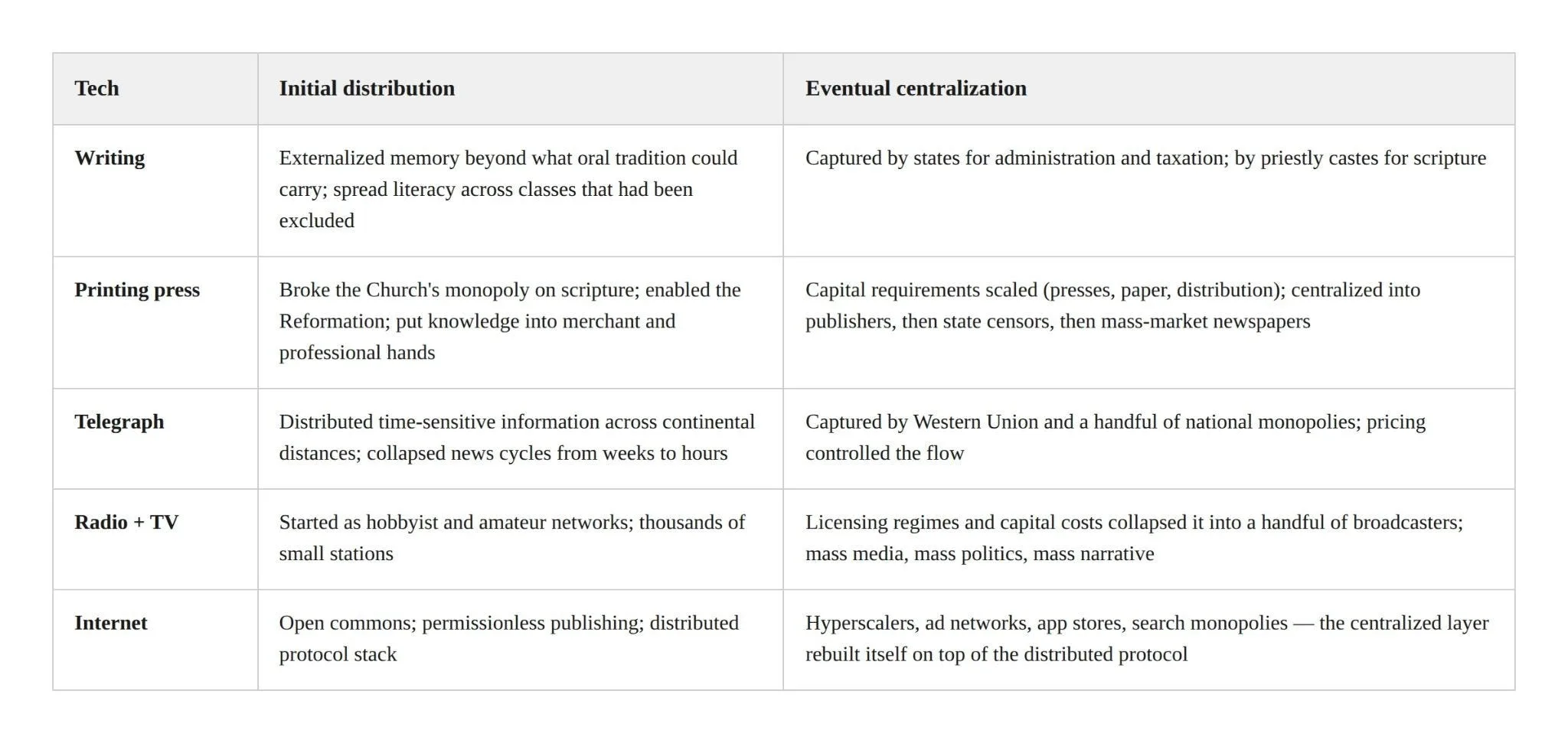
The pattern is consistent: each technology distributes first, then re-centralizes as the infrastructure scales. The mechanism is the same one this article opened with — networks naturally produce monopolies. Once the scaling cost is high enough that only a few entities can pay it, the few entities become the new gatekeepers.
The shared function those gatekeepers perform is what makes this pattern dangerous: measuring and certifying what counts as important. Priests certified truth. Editors certified news. Statisticians certified reality. Search engines certified relevance. Each technology distributed who could access the knowledge. Each centralization re-captured who decides what the knowledge means.
AI is the next instance of this pattern, and it’s worse than the others — because it doesn’t inherit one gatekeeping function. It absorbs all of them at once. What counts as a fact, what counts as a useful answer, what counts as worth reading. One model, one company, one jurisdiction, deciding for billions.
Layered on top: Toffler’s Powershift (1990) names the framework for why this particular instance matters more. Power has three components — violence, wealth, knowledge — and knowledge is the highest-quality form. Non-rivalrous. Infinitely elastic. The most concentrable thing humans have ever produced. Each historical era is defined by which of the three components dominates. Pre-industrial: violence. Industrial: wealth. Now: knowledge. Toffler called it before the public web.
AI is the amplifier of knowledge-power. Centralized AI = the highest-quality form of power, controlled by the fewest hands in human history. Autonomist AI = the highest-quality form of power, distributed for the first time and staying distributed — because this time, the architecture is being built with awareness of the pattern.
That last part is what makes this moment different from previous waves. The first time we’re applying communication technology with the receipts of every previous failure in front of us. Whether we use them is the question.
c. The physical math doesn’t work
Even if the politics worked, the physics don’t.
Centralized AI is the most resource-intensive computing architecture humans have built. Today’s data centers in Northern Virginia consume one in five kilowatt-hours from the state’s largest utility. Texas data centers project 399 billion gallons of water per year by 2030. Google used 6.1 billion gallons in 2023. Most of that water evaporates and never returns to the local aquifer. The grid is already saturated — AEP Ohio paused all new data center interconnections. Morgan Stanley estimates a 49 GW US power shortfall through 2028.
The cooling problem is an ecological extraction problem in disguise. Centralized data centers draw community water, run it through their racks, and release it heated or evaporated. Watersheds get stressed at the local scale to support compute happening for users in another country.
This is today, with mostly human-triggered queries.
The near future breaks the model. When every person runs dozens of agents continuously, when every machine has its own, when agents call other agents in sustained background loops, the load multiplies by orders of magnitude. A hundred agents per person, eight billion people, running continuously — no hyperscaler buildout can physically supply that. The grid can’t generate it. The aquifers can’t cool it. The fabs can’t print enough chips to host it.
There is one architecture that scales to that demand, and only one: distribute the compute to where the agents already live. Phones. Laptops. Home servers. Edge nodes. Local hardware dissipating tens of watts into ambient air, drawing on rooftop solar, never touching a community watershed.
Local AI isn’t a preference. It’s the only physical solution to the agent-multiplication problem.
d. Centralized AI degrades by default — race to the bottom
Two race-to-bottom mechanisms operate at different layers.
The platform race-to-bottom you already know. Facebook to AI-slop. Twitter to rage-engagement. Google Search to SEO spam. Once a centralized platform locks in the network, growth slows. The platform stops competing for users and starts extracting from the ones it has. Engagement replaces utility. Quality decays asymptotically. Different CEOs, different decades, same outcome — because the architecture forces it.
The AI-specific race-to-bottom is sharper and structural. It has a name in the research literature: model collapse. A centralized model trains on its own output sooner or later. The internet fills with AI-generated text, which becomes the next training corpus, which produces models trained on synthetic data, which produces more synthetic data. The signal degrades through each iteration. Studies from 2023 through 2025 show the effect is real and measurable — even 1% synthetic contamination can trigger collapse, and scaling the model or the dataset doesn’t reliably prevent it. High-quality human-written web text isn’t infinite, and most existing datasets are already partially polluted.
Synthetic data won’t fix this. It can fill gaps, but it can’t add the new information that comes from real human interaction with the real world. A few large models drinking from each other’s output is a closed loop. Closed loops decay.
A diverse ecosystem of local, specialized, openly-trained models doesn’t have this problem. Different training data, different fine-tunes, different feedback loops, different signal sources. The diversity is the resistance to decay. Centralization eliminates it by definition.
e. Local is necessary. Open source is also necessary.
A closed model running on your hardware is theatre. It looks sovereign but isn’t. It can leak data on triggers you can’t predict. It can change behavior on update. It can refuse instructions in ways you didn’t authorize. You can’t read it, so you can’t check it. You better have your check of the code.
This is the lesson the server world learned in the 1990s. Linux administrators didn’t choose open source out of ideology. They chose it because they had to operate the systems and needed to know what the systems were doing.
There’s a second reason for open source that has nothing to do with trust: it iterates faster. Kevin Kelly summed it up in five words: “Nobody is as smart as everybody.” That’s the open-source thesis compressed. Closed AI compounds linearly — one company, one team, one roadmap. Open AI compounds combinatorially — every fork, every fine-tune, every published improvement. Llama 1 leaked in February 2023; within sixty days, the open community produced derivatives that beat the original. Stable Diffusion overtook DALL-E within a year. Kimi K2.6 sits ten points behind Claude Opus 4.7 on Tier A coding benchmarks, and the gap closes faster than the closed labs widen it.
Three axes:
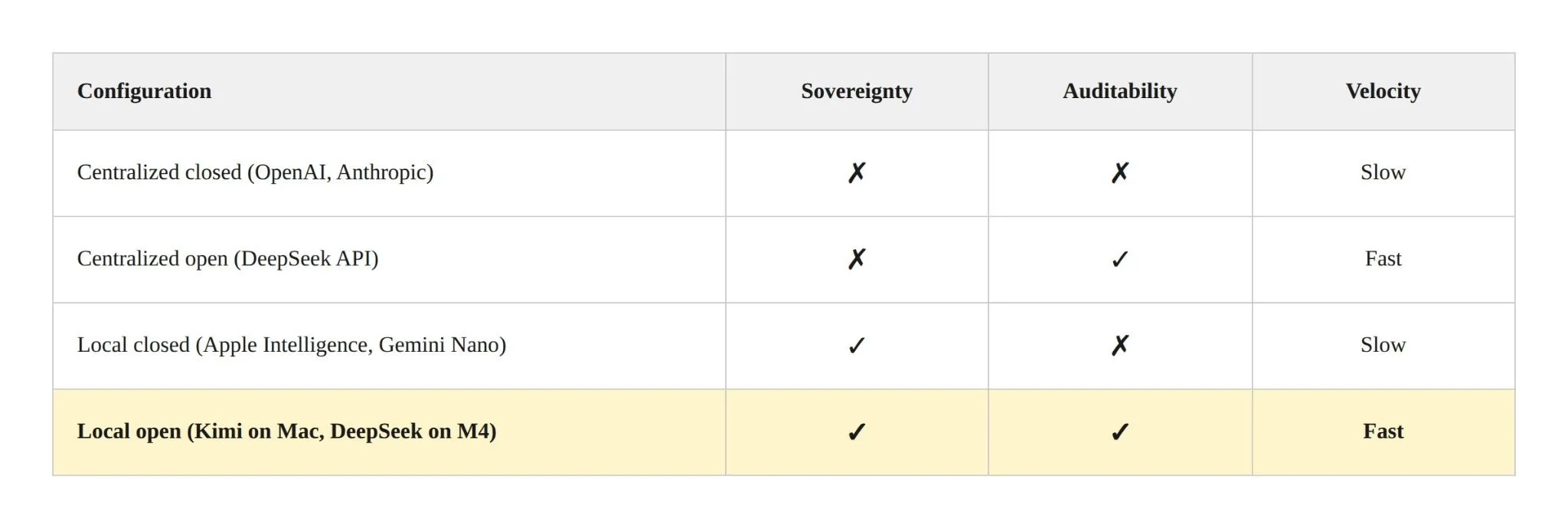
Local + open is the only configuration that wins on all three.
Centralized AI fails at the structural level (gatekeeping the dominant power form), at the physical level (water, power, scaling), and at the model level (race to the bottom). The configuration that solves all three is local, open.
The current trajectory
This is where centralized AI is heading, on its current path.
Three companies hold the compute layer of the global economy. AWS at 33% market share. Azure at 22%. Google Cloud at 11%. All three US-domiciled, all three subject to the Cloud Act — which authorizes the US government to compel data on US providers regardless of where it physically sits. A bank in Frankfurt running on AWS Frankfurt is, legally, accessible to a US subpoena. A hospital in Sydney running on Azure Australia is accessible to a US subpoena. The hardware location doesn’t matter. The corporate domicile does.
On March 2, 2026, an Iranian drone strike hit an AWS facility in the UAE. Abu Dhabi banks went offline. AWS told its Middle East customers to migrate workloads to data centers in other regions — meaning, in practice, send your customer data and your transaction records out of your jurisdiction to keep your service running. Sovereignty traded for uptime. Both lost in the same incident.
This is today. The agent era multiplies it.
AI agents consume ten to forty times more tokens than humans per active session. Multiply that by the projected agent population — dozens to hundreds per person, running continuously — and the load on centralized infrastructure goes parabolic. Northern Virginia’s data center hub is projected to fall out of electricity reliability standards by June 2027 because of AI load alone. That’s not a forecast about a distant future. That’s fourteen months from now.
The asymmetric risk is sharper than uptime. Take down a website, you lose a website. Take down agentic infrastructure, and you lose the physical processes the agents run — payments, logistics, healthcare, energy, transportation. Worse: you lose the data people have entrusted to those systems. Legal documents. Medical records. Financial histories. Trade secrets. Strategic plans. Personal correspondence. Every confidential thing a user fed to an AI to get help with sits inside the centralized model’s context, the centralized provider’s logs, the centralized cloud’s backup tape. A breach isn’t a service outage. It’s the largest exfiltration event in human history, all from the same handful of targets. Hackers know this. So do competitors. So do hostile states running hybrid warfare playbooks. The honeypot is built and well-marked.
Now layer on what’s running on these systems: the model that will write your contracts, run your business, manage your data, and eventually drive your machines. The system you’re trusting to certify what counts as a fact, what counts as a useful answer, what counts as worth doing. The most powerful tool humans have built, run by three companies, in one jurisdiction, with one legal regime, with one set of incentives.
This is the trajectory. It’s not a prediction. It’s a description of where we are now, looking at where the lines extrapolate.
The centralized AI cathedral is the perfect target. For missiles — Iran and Ukraine showed what happens to centralized command under fire. For drones — AWS UAE showed what happens to centralized cloud under physical attack. For data exfiltration — the architecture itself is the vulnerability. Same architecture. Three failure modes. All running in parallel.
Tools for autonomism: what’s already working
Each layer of the stack has its own answer for local and open. Most tools today are some of one and not enough of the other. The frontier is the tools that are both.
Open-source frontier models, Chinese-led
The proof of concept. Kimi K2.6 from Moonshot, released April 2026, sits ten points behind Claude Opus 4.7 on Tier A coding benchmarks. Open weights. Qwen3.6, DeepSeek V4, GLM-5.1 — all 2026 releases optimized for inference on consumer hardware. Mixture-of-experts architectures designed to fit consumer memory.
China is doing to AI what Iran did to military command and Ukraine did with drones — deliberate redundancy, deliberate distribution. Whether the motive is geopolitical or commercial doesn’t matter for the result. The result is a global open-weights frontier that closed labs can’t lock down.
Mac Mini sovereignty
Local hardware running open weights. Both checks. Currently the cleanest end-user implementation.
An M4 Pro Mac Mini with 64GB unified memory runs 32-billion-parameter models at 10–15 tokens per second. Qwen3-30B-A3B runs at 17 tok/s on a 16GB Mac Mini using llama.cpp. Cost: under $2,000. Power draw: about 30 watts versus 600+ watts for a comparable PC GPU rig. The power bill of a desk lamp.
People are running this today. Quietly. In small offices, in home setups, on developer benchmarks. Not theoretical. Already shipped.
ICP and Cloud Engines: sovereign, not local
The bridge layer. Worth being honest: ICP is sovereign but not local. The compute runs on a global subnet of nodes you don’t own. The smart contracts (canisters) are open-source. The runtime is shared.
What it gets you is real. The Swiss Subnet, launched at World Computer Day in Davos on January 20, 2026, runs 13 independent nodes across Switzerland and Liechtenstein. All data storage and processing stay within Swiss borders. Architecturally incapable of complying with foreign government compulsion. Designed for banks, hospitals, government bodies — institutions that need verifiable sovereignty and can’t get it from US hyperscalers. Cloud Engines — DFINITY’s productization of configurable private subnets — are the next layer on top, with the public demo scheduled for May 10, 2026.
What it doesn’t get you is the device-on-your-desk model. ICP is sovereign cloud, not local AI. It’s the bridge — useful where pure local isn’t yet viable, and where the alternative is the centralized US cloud. Worth flagging: Dom Williams sketched a version of this in 2021 — the BADLANDS concept. We’ll come back to it.
Smartphone AI: half the answer
Apple Intelligence on iOS. Gemini Nano on Android via AICore. Both shipping today. Both running on-device. Both local.
Both also closed.
OpenAI is partnering with Qualcomm and MediaTek on a custom processor, with Luxshare as exclusive co-design and manufacturing partner — confirmed by Ming-Chi Kuo on April 27, 2026. Mass production targeted for 2028, projected at 300–400 million annual shipments. The thesis: AI agents replace the mobile OS as the primary interaction layer. Qualcomm CEO Cristiano Amon has been making the same argument throughout 2026 — the hardware needs to be designed from scratch for continuous on-device agent inference, not retrofitted with NPUs bolted on.
The opportunity here is the open layer running on top of the closed default. MLC, llama.cpp on iOS, Termux on Android. People running open models on devices designed to run only the manufacturer’s models. The infrastructure (NPUs, unified memory, sub-30W power) is converging in autonomism’s favor. The question is whether the user gets to choose which model runs — or whether the manufacturer chooses for them.
Edge and machine economy
Akash Homenode — peer-to-peer compute mesh from idle home hardware. Local inference, local energy, peer-to-peer trading. The structural answer to the energy ceiling: instead of building bigger data centers, distribute the compute to hardware that already exists in millions of homes.
This is the infrastructure layer where AI meets the physical world. Open, local, finally getting real.
Mesh networks
The architectural endpoint.
A mesh network needs no internet, no cellular network, no central coordinator. Devices talk directly to other devices nearby — Bluetooth, Wi-Fi Direct, peer-to-peer radio. Each phone or node relays messages for the others. The more devices on the mesh, the better it works. There’s no tower to switch off, no server to seize, no provider to coerce.
The most beautiful proof of concept came in Hong Kong, 2014. During the Umbrella Movement, students used FireChat — a mesh app from Open Garden — to coordinate protests when cellular networks were either overloaded or feared shut down. 500,000 downloads in two weeks. 10.2 million chat sessions. The cellular network being overwhelmed didn’t matter; the mesh got stronger the more people joined. Christophe Daligault, then at Open Garden, described it cleanly: “Once you build a mesh network, you have a network that is resilient, self-healing, cannot be controlled by any central organization, cannot be shut down and is always working.”
FireChat itself didn’t survive — the app was discontinued by 2018 — but the proof held. Multiple projects are now working the same architecture for AI inference and coordination: Mesh AI, OptimAI, Akash Homenode, Meshcore, Reticulum. Most early-stage. None proven at the scale FireChat hit.
State this honestly: the direction is clear. The production-grade implementation is not. This is the part of the toolkit still being built.
The ideal — what convergence looks like
Take everything above and project it forward five to ten years.
The ideal model is open source — and not one model. Several specialized models, smaller and sharper than today’s frontier, each tuned for a domain: medicine, law, code, design, your specific work, your specific home. Running alongside them are personal agents that hold your context, your history, your preferences. You own them. They run for you.
All of it runs on the descendant of what we call a smartphone today. A pocket device with enough silicon, memory, battery, and connectivity to handle the bulk of what your digital life requires. The vectors are visible in the specs: 80% of recent Qualcomm SoCs already include an NPU. Snapdragon 8 Elite Gen 5 runs 56+ models in under 5 milliseconds. Qualcomm’s next architecture pairs 40 TOPS of NPU compute with 4GB of stacked 3D DRAM, shipping late 2026 to early 2027. Forecasters are projecting 1,000 TOPS distributed across personal devices by 2030. The phone in 2030 will do what a server rack does today, on a battery, in your pocket.
That’s the hardware story. The software story runs in parallel: open weights getting smaller and sharper through quantization and mixture-of-experts, mesh protocols maturing, runtimes like LiteRT abstracting away the chip-vendor lock-in. The behavioral story runs alongside both: people moving back to local-first as the cost of cloud dependency keeps showing itself, the way they moved back to physical notebooks once cloud-stored notes started getting deleted, monetized, or scanned.
I’m naming the hardware deliberately. The convergence isn’t coming from one direction. It’s coming from all of them at once — silicon shrinking, software opening, social norms shifting, behavior adjusting. Hardware constraints fall as software constraints fall as social norms shift as user behavior changes. Each one accelerates the others.
The endpoint isn’t a single product. It’s a stack: open models, local hardware, sovereign cloud where local can’t reach, mesh resilience underneath, personal agents on top, encrypted state in your hand. None of those layers is finished today. None of them is impossible. Each is being worked on by people who don’t know they’re working on the same problem.
Now go back to BADLANDS. In 2021 Dom Williams sketched ICP nodes running on $250 Raspberry Pi boxes — anonymous amateur node providers from home, maximum decentralization. The architecture was right. The hardware wasn’t there yet. A Pi in 2021 couldn’t carry the load.
Replace the Pi with the pocket device of 2030. The phone you already own, with NPU compute and stacked memory and persistent connectivity, becomes the BADLANDS node. It runs your local models. It carries your share of the ICP subnet. It handles your identity, your contracts, your value transfer. Five billion devices already shipped, billions more on the way — distribution Dom couldn’t have engineered, delivered to him by Apple and Qualcomm and Samsung. The vision he had in 2021 is finally meeting the hardware that makes it real.
The only piece still missing is the mesh layer underneath — the part that makes the whole thing work when there’s no internet. That’s what Hong Kong demonstrated in 2014 with FireChat, the part that hasn’t yet shipped at production grade for AI workloads, and the part being built right now by Akash Homenode, Reticulum, Meshcore, and the others. When mesh matures, the stack is complete. Pocket device as BADLANDS node, plus mesh underneath — autonomism on the infrastructure that runs the economy.
That’s the convergence. Not a prediction. A description of vectors already in motion.
Honest trade-offs
Today, these are at embryo state. Not finished products. Not enterprise-ready. Some are barely working. Initiatives, prototypes, early commits.
Frontier models still require centralized training runs that no individual or small organization can finance. Local models lag the frontier by six to twelve months. Mesh networks add latency and reliability variance that real workloads don’t yet tolerate. BADLANDS-class hardware exists as an idea, not as a product. Sovereign clouds like ICP are bridges, not destinations. Open-source weights ship, but most still get downloaded and run from a centralized provider’s API.
All true. All temporary.
And speaking about embryos, it’s like having kids. The first years are pure liability. They eat. They cry. They break things. They give nothing back. Anyone running cost-benefit at month six concludes it was a mistake. The numbers say so. The investment is high, the return is zero, the projection — based on the data available at month six — is that it will continue this way indefinitely.
But the math isn’t computed at month six. It’s computed across decades.
And these tech embryos aren’t growing in a static environment. Everything around them is converging — storage capacity, network speed, chip efficiency, power grid evolution, edge silicon, software stacks, regulatory frameworks. Mesh latency today is what modem-on-copper was in 1998. Fiber arrived. So did 5G. So will whatever comes next. The same curve will close every constraint listed above.
The mess is the investment. The asset is what it becomes.
Buckminster Fuller said it cleanly:
“You never change things by fighting the existing reality. To change something, build a new model that makes the existing model obsolete.”
The cloud-AI cathedral isn’t being torn down. It’s being made irrelevant by what’s growing in the gaps. Chinese open weights running on Mac Minis in offices nobody hears about. Smartphones hitting NPU thresholds that put yesterday’s data centers in your pocket. Sovereign subnets in Switzerland and Liechtenstein. Mesh nodes in the projects you haven’t read about yet. None of it announces itself. All of it accumulates.
Toffler’s 1980 framework was that industrial-age centralization wasn’t a feature of civilization — it was a response to the era’s communication and energy constraints.
The same logic now applies to compute. Centralized AI is the perfect Second Wave architecture — concentrated, hierarchical, fragile under attack, decaying under its own incentives. The alternative is no longer theoretical. Open weights match closed weights on the benchmarks that matter. Pocket devices are reaching server-rack capability. Sovereign clouds are shipping. Mesh protocols are maturing. The toolkit is here. The convergence is in motion.
AI should be local. And open source. Not as preference. As the only configuration that survives the test it’s about to face.