
Disclosure: I build in this space — on the Internet Computer (ICP), a sovereign compute network, and on the machine layer described near the end. It continues an earlier piece, “The Autonomous Machine Cloud,” which built the machine side; this one asks what kind of organization runs on it.
EVERY ORGANIZATIONAL FORM IS AN ARTIFACT
Every era has a dominant way of creating value, and a dominant form that organizes it. We treat the form we were born into as natural. It isn’t. It’s an artifact — shaped by the tools available at the time, and by the tools that were missing.
Take centralization. We think of the big organization as the natural way to do anything serious: gather people in one place, stack them in a hierarchy, point them at a goal. But organizations centralized because they had no choice. For most of history there was no way to coordinate work across distance. No telephone, no network, no shared real-time information. If you wanted people to work together, you put them in the same building under the same boss. The factory, the head office, the chain of command — these were workarounds for missing communication tools, not the natural shape of work.
Each era got the organizational form its tools allowed. The manor organized agricultural value around land you couldn’t move. The guild organized craft around skills that took a lifetime to learn and had to be passed hand to hand. The corporation organized industrial value around machines too expensive for any individual to own. In every case the form fit the tools — and when the tools changed, the form changed with them. The guild didn’t lose a debate. It lost its reason to exist.
We have new tools now: AI, blockchain, cheap hardware. So the question isn’t whether the organizational form changes. It always does. The question is what the new form is — and most of the people answering are getting it wrong.
WHAT TO CALL IT — AND WHO’S GETTING IT WRONG
There are two kinds of answers to this question. Both wrong.
The first is the “guru” answer: the conference speakers, the thread-writers, the men who coin a phrase and sell it back to you. “Organizational singularity.” “The one-person unicorn.” The slogan is the product; there’s nothing under it. And the prediction is always the same move: they draw a straight line out of today and call it the future. That’s what an expert is — someone who understands the present so well he assumes tomorrow is just a bigger version of it. He extends the line. He never sees the break in it.
The second kind is more honest, because these are real builders, not professional speakers. They run real infrastructure and describe what they can already see working. Their answer to “what replaces the corporation” is: a better corporation — rebuilt around AI, run by agents, given a live model of itself. Some call it The Cybernetic Organization. It’s honest and it’s sharp. It’s also still a corporation. They reach for the smaller change because the smaller change is legible — improve what exists, don’t replace it.
All these answers are made of software, all the way down. That’s not an accident. Almost everyone naming the future comes from software — the gurus, the venture capitalists, the commentators, the builders. Software is where the money and the attention have been for twenty years. Hardware is the poor relation: slow, capital-heavy, unglamorous.
Name the last great hardware unicorn. You’ll struggle — and the one name you land on, Musk, is the exception that proves the rule: the single figure who bet on atoms while everyone else ran to bits.
So when these people picture the new economy, they picture it in bits, because bits are what they know. The atoms get left out by people who never worked with atoms.
Chris Anderson is the one who pointed the other way. Former editor of Wired, then he went and built a drone company — applied the thesis he’d written about, shipped real hardware, took real losses when China out-built him. His explanation came from the work, not the other way around. And the phrase he carried still holds: hardware is the new software. That’s the door the software people walked past. This is about walking through it.
EVERYTHING AUTONOMOUS
One thing drives all of this change: autonomy.
Not decentralization — that only names what we’re leaving behind: the central office, factory, server, bank. It names the dismantling, not the destination. The destination is autonomy.
It comes in two halves.
We solved the first one — software. AI agents read, decide, and act on their own. That half was easy: pure bits, fast, cheap, the best return on investment in the economy, so that’s where everyone went.
The second half is hardware, and it’s harder. A machine that manages itself — takes a job, does it, gets paid, covers its costs. Autonomous cars are the first real case, and they’re nearly here.
When autonomous machines join autonomous software, we get what we always wanted: individual autonomy. Work from home. Earn directly. No boss, no commute, no being fired. One person, with self-running software and self-running machines, can do what used to take a company.
Autonomous software + autonomous hardware = the autonomous individual.
And once the individual is autonomous, the form that organizes their work changes with them. You don’t need a corporation anymore. You need something that forms around a project and dissolves when it’s done. Call it The Autonomous Venture.
CAPITAL, COORDINATION AND TALENT — WHY IT BEGAN
To see why the corporation is ending, you have to see why it started. It wasn’t natural and it wasn’t permanent. It solved three specific problems. Take the problems away and the solution has no reason to exist.
Capital. The means of production cost a fortune. A factory, the machines, the assembly line — no individual could afford them. You had to pool money from many people to buy them. That pooling is what the word capitalism comes from: you needed capital, a lot of it, up front, just to start. And whoever put up the capital owned the thing and hired everyone else to run it.
The banks that lent the money wanted a permanent entity to lend to — something that would still be there in twenty years to pay them back. Permanence wasn’t a choice. The capital structure demanded it.
Coordination. In 1937 Ronald Coase asked a simple question: if markets are so efficient, why do companies exist at all? Why not just hire each task on the open market as you need it? His answer: because of transaction costs.
Using the market costs something — finding people, negotiating, writing contracts, enforcing them. Past a certain point it’s cheaper to bring the work inside, put people on salary, and direct them. The company exists because internal coordination was cheaper than market coordination. The boundary of the firm sits exactly where those two costs meet.
Talent. Bill Joy, who co-founded Sun Microsystems, put it plainly: no matter who you are, most of the smartest people work for someone else.
A company can only hire a sliver of the talent that exists. So it hires what it can and locks it in — salaries, offices, contracts, non-competes — because talent was scarce, hard to find, and had to be held in one place to be useful.
Capital, coordination, talent. Three real problems, one solution: gather money, people, and tools into a single permanent entity and point them at a goal. That entity is the corporation. It was the right answer for two hundred years.
CAPITAL, COORDINATION AND TALENT — UNDONE
Each of the three reasons is now disappearing. Not one of them. All three, at the same time.
Capital. The means of production are collapsing in price. You no longer need a factory to make things — a 3D printer, a CNC mill, a laser cutter sit on a workbench and cost a few hundred to a few thousand. Software runs them. The plant that once needed millions and a hundred workers is becoming a room of machines one person can own or rent.
When the means of production cost almost nothing, you don’t need to pool capital to start, and you don’t need a permanent entity to amortize it. The reason it was called capitalism is going away. How far this goes — energy, materials, the whole cost structure — is the heart of the matter, and I’ll come to it.
Coordination. Coase’s cost — the cost of using the market instead of a hierarchy — is going to zero. This is what AI agents and smart contracts actually do: find the counterparty, negotiate the terms, write the contract, execute it, settle the payment, with no salaried middle layer running the process.
When coordinating on the open market becomes as cheap as coordinating inside a company, the company’s whole reason for being — that inside was cheaper — is gone. The boundary dissolves from the outside in.
Talent. Joy’s ceiling is lifting. You no longer have to hire the smartest people and hold them; you summon the capability when you need it. AI supplies a large share of it on demand, and the human talent you do need joins for a project and leaves when it’s done — no payroll, no office, no lock-in.
Talent stops being something you hold and becomes something you access.
Capital, coordination, talent — the three pillars the corporation stood on, all going soft at the same moment. A structure loses its reason to exist when the problems it solved stop being problems. That is happening now, to all three at once.
MANAGERIAL CAPITALISM — THE LAST BREATH OF CORPORATIONS
If the corporation’s reasons are gone, why is it still standing? Because things don’t fall the moment they’re obsolete. They run on inertia.
Watch what happened. The owners — the people whose capital built the firm — gradually stepped back, and a professional class moved in to run things on their behalf. Managers. People trained not in any trade but in management itself, the MBA as a license to run anything: a hospital this year, a bank the next, a software company after that. They don’t build the product. They don’t own the company. They coordinate — they move information up to whoever decides, and push the decision back down.
Which is exactly the function that’s now disappearing. A manager’s job is to route information and approvals through a hierarchy. That is a coordination task — the same task smart contracts and agents now do automatically, in real time, for almost nothing. The whole layer can be replaced by a few rules written in code.
So the thing replacing the manager isn’t a better manager. It’s the rule-set — the governance written into the venture itself.
The crowd has a name for that already, inherited and imperfect: the DAO.
Set the word aside for a moment; what matters is what it does. It does what the management layer did, without the layer.
THE AUTONOMOUS VENTURE
The autonomous venture — named a few sections back as what the autonomous individual builds instead of a company — is best understood against the thing it replaces.
A corporation is a permanent container for people, capital, and tools.
An autonomous venture is a temporary assembly: it pulls together whatever the job needs — software agents, machines, a few people — runs on a rule-set instead of a management layer, settles its accounts in real time, and ends when the work ends. Compare them directly:
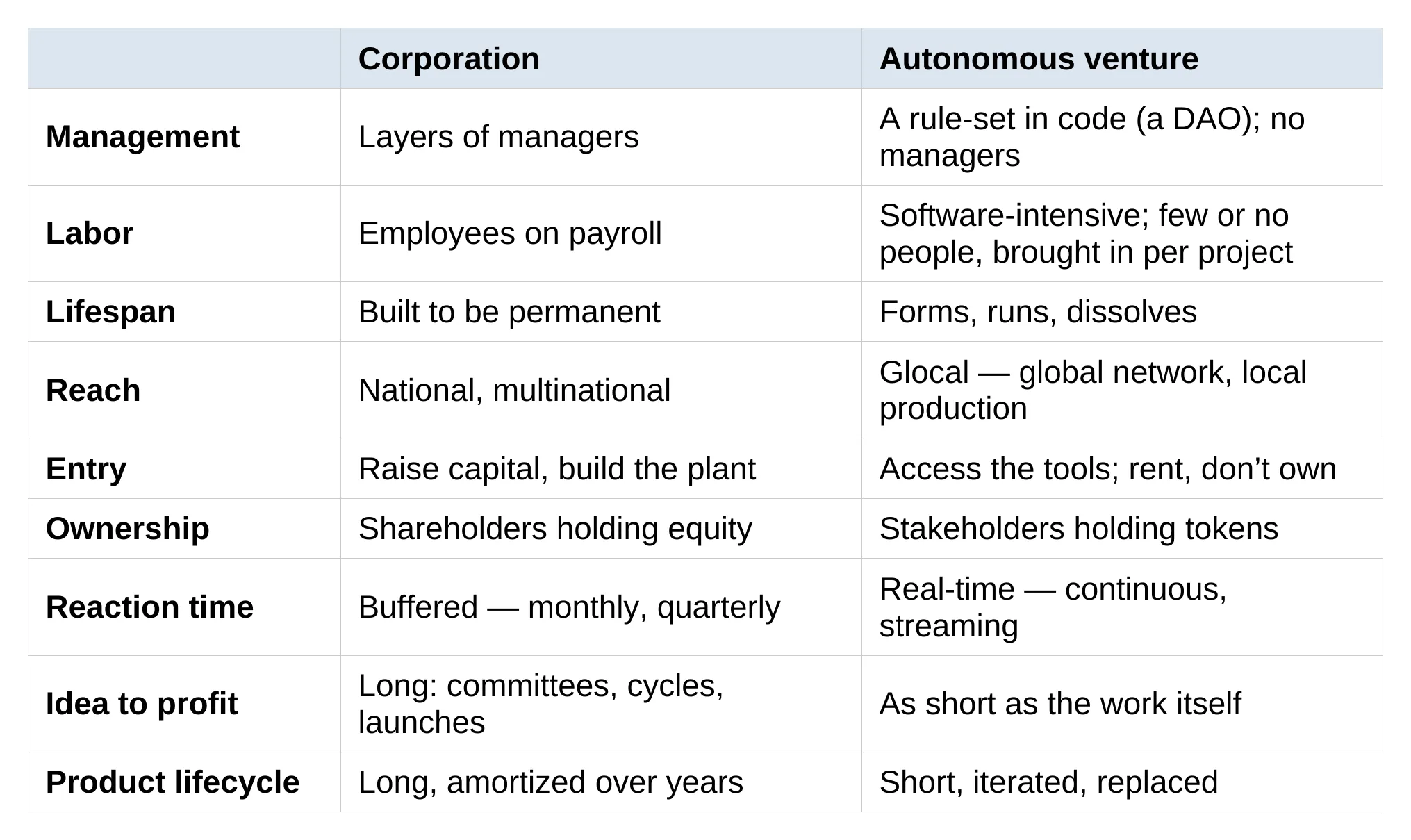
Three rows matter most.
Management becomes a rule-set.
Everything the management layer did — who decides what, how money moves, who gets paid when — is written into the venture as code.
No managers to route it. The rules run it.
Reaction time goes from buffered to real-time.
A corporation batches everything because it had to: paychecks monthly, invoices on thirty-day terms, results reported quarterly. These are reservoirs that hold events until there’s enough to process in a batch — leftovers from an age when information couldn’t flow continuously.
An autonomous venture has no batches. Work is paid as it’s delivered. The books are always current because they’re the ledger itself. It reacts in the moment, the way the corporation never could.
Ownership becomes access.
You don’t raise millions to build a plant. You don’t even own the machines — you reach them, on demand, the way you reach computing power in the cloud. For physical production that shared layer has a name, the Autonomous Machine Cloud, and I’ll come to it.
The entry ticket that defined capitalism — the capital you needed just to begin — drops toward nothing.
ONE PERSON VENTURE
Who runs an autonomous venture? It can come down to one person.
The corporation needed many people because the work needed many hands and the coordination needed managers. Strip both — software does the work, the rule-set does the coordination — and the venture can be run by a single individual.
Not a founder with a hundred employees. One person, with autonomous software and autonomous machines doing what the hundred used to do.
We already have a name for that person, though it’s a transitional one: freelancer.
Today a freelancer sells their own time, one client at a time. But give that same person AI to do the work and machines to make the things, and “freelancer” stops describing it.
They’re no longer renting out hours. They’re running their own ventures.
Toffler had the better word forty-five years ago: prosumer.
The prosumer is the autonomous individual seen from the economic side: someone who produces value directly, without a company standing between them and the work.
Even better: when software and machines carry the load — autonomously — one individual can run several ventures at once. Start them, let the ones that work grow, shut the ones that don’t. The unit of a career stops being the single company you spend your life on. It becomes a portfolio of ventures that come and go.
Legally, through all of this, the person is just a sole proprietor — a freelancer, as far as the tax office is concerned. That matters more than it sounds, and it’s the reason you can start now. I’ll come back to it.
HARDWARE IS THE NEW SOFTWARE
Start with how software became abundant. It became cheap to copy — the marginal cost of one more copy fell to nearly zero.
That single fact built the entire software economy. Make it once, sell it a million times, each copy costing almost nothing. Nothing in the physical world worked that way. Atoms had to be mined, shaped, shipped; each unit cost real money to make.
Jeremy Rifkin saw the physical side beginning to shift. His argument, in short: a new era is born when a new energy source meets a new way to communicate.
- The first half of the industrial revolution paired coal and steam with the printing press.
- The second paired oil and the combustion engine with electronic communication — telephone, radio, television.
- The current era is renewable energy meeting the internet — both distributed, both lateral, neither needing a center.
He also saw that competition does to physical goods what it always does: drives the cost of making one more unit down, and down, toward zero. It’s called Zero Marginal Cost.
Solar energy, once the panel is paid for, costs almost nothing per kilowatt-hour. Additive manufacturing builds only what’s needed, with little waste.
The cost of making things falls the way the cost of copying software fell. Rifkin’s conclusion was that this eventually undoes capitalism itself — when the next unit costs nothing, there’s no profit in it, and abundance replaces scarcity.
But Rifkin was missing two things that didn’t exist when he wrote: AI and blockchain. His machines were sensored — they could measure and report — but they were still dumb, still watched and run by people.
AI lets a machine decide. Blockchain lets it transact.
Put those together and the machine stops being a tool someone operates. It becomes an agent — it can take a job, do it, charge for it, pay its costs, on its own. The same standing as a software agent. They can deal with each other as peers.
If that sounds far off, look at cars. A car that drives itself through a city — reading the world, deciding, acting, second by second — is a far harder problem than a milling machine or a vending machine running itself. The hardest case is already on the road. The rest is easier.
AN ECOLOGY OF AGENTS
Humans, software agents, and machine-agents, each a different kind of thing, each only as capable as its job requires, all transacting on the same network. A pricing agent, a delivery drone, a fab cell, a person — different species in the same system, the way an ecosystem runs without anything in charge of it.
And these machine-agents need somewhere to meet, coordinate, and transact. For software we built the cloud. The same model now fits hardware — and fits it better, because hardware is local by nature. A machine only exists in one place at a time.
So the network is global but the work is local: global discovery and settlement, local production and delivery.
Machines join as small self-governing units — a single machine, a fab cell, a neighborhood of them — owned by stakeholders, run by their own rules.
This is the layer I’ve spent years building - The Autonomous Machine Cloud - and I’ve described how it works in detail elsewhere; here it’s enough to say it exists, and it’s what the autonomous venture runs on when the work touches atoms. The machine layer the autonomous venture needs — the part that touches atoms — is being built.
STARTING BEFORE THE RULES EXIST
None of this arrives on a schedule. The technology is here, but the world around it isn’t ready — and that gap is where you have to operate.
The tools exist: sovereign compute, real-time settlement, AI that does the work, machines that are starting to run themselves.
What doesn’t exist yet is everything institutional that has to form around a new way of working — the laws, the accounting rules, the legal recognition of a thing that isn’t a company. Those take time, and they take it on purpose. As Clay Shirky put it, institutions will try to preserve the problem to which they are the solution. The accountants, the regulators, the corporate lawyers — each is the answer to some friction of the corporate era, and each will work to keep that friction alive.
So it goes the way these things always go: first they ignore you, then they fight you, then you win.
Blockchain is only now coming out of the fight-you stage, fifteen years in.
Triple-entry accounting — books that keep themselves because they are the ledger — runs straight at the accounting profession, the audit firms, and the tax authorities all at once.
That fight has barely started. Expect it to be long.
Which doesn’t mean you wait. It means you start inside today’s rules.
There’s a simple way in, and it’s already legal everywhere — the same freelancing we came to earlier. Here is the shape of it in practice.
Several freelancers — or just one, with AI and machines — coordinate through a DAO: the rule-set decides who does what, how the money splits, who gets paid when, all in code.
That coordination is the autonomous venture. There is no company holding them; there is a shared set of rules they each plug into and leave when the work is done.
To anyone on the outside, it’s a handful of independent people working together on a project. Underneath, the rules are doing what a manager and a head office used to do.
Recall that the operator of an autonomous venture is, legally, just a sole proprietor. To the tax office, someone running a venture this way is a self-employed person earning and declaring income, nothing more.
What the system doesn’t see, because it has no category for it, is the layer underneath — the rule-set coordinating the work, the agents, the machines. The income is visible and fully declared. The structure is invisible because no one has any reason to ask about it.
THE HYBRID — AND WHAT COMES AFTER
Come back to cars one last time, because they tell the whole story in miniature.
The combustion engine ran the last century. Then the electric car arrived — not a better engine, a different machine.
In between sits the hybrid: an electric motor bolted onto a combustion core, two systems in one car, built to ease the crossing for an industry that couldn’t jump straight.
The same three forms are here for the organization.
The corporation is the combustion engine — the old core, managers and payroll and quarterly reports.
The cybernetic organization, the smarter company the serious builders describe, is the hybrid — new power bolted onto the old chassis, still a company underneath.
And the autonomous venture is the self-driving electric car — built fresh, nothing of the old structure carried over.
Who builds which is decided by what they have to protect. The incumbents build hybrids because they have a century of plant and habit to defend, and the hybrid is the only move that adds the new without giving up the old.
The ones with nothing to protect build the new thing outright. Tesla never had a combustion legacy, so it built electric and is now out-shipping the giants that did.
Tony Seba predicted exactly this collapse years before it was respectable, was dismissed, and watched it happen faster than even he said.
The firm’s transition will run slower than the car’s — its supports are buried deeper, in law and money and tax, not just steel — but the shape is the same.
Hybrids don’t win the new era. They make the wait survivable for the people who couldn’t build the new thing in time.
So, the whole argument in one line. Autonomy is the direction.
It came first to software, which is why everyone sees that half. It’s coming to hardware, which is the half still being built.
Autonomous software plus autonomous hardware makes the autonomous individual — and the autonomous individual still needs a way to organize work.
That way is the autonomous venture: it assembles for a job, runs on a rule-set instead of managers, and dissolves when the work is done.
Ventures find each other, partner, and settle with one another on the fly — one venture’s output feeding the next — and the web of them, forming and dissolving, is the new economy.
This is not a better corporation. It’s what comes after the corporation, the way the corporation came after the guild — not by winning an argument, but by making the old form pointless.
The industrial era centralized everything because it had no choice. We can distribute everything because now we do. That shift has a name. The era is Autonomism, and the autonomous venture is the unit it runs on.
The machine layer this all depends on — the part that lets a venture reach into the physical world — is its own subject, and I’ve laid it out in full in “The Autonomous Machine Cloud.”
Start there if you want to see how the atoms get done.